Acoustic consultants
Model junctions and flanking paths, not just wall ratings.
Model the space.
See the sound.
A browser-based 3D modeling platform for building acoustics. Import a floor plan, build the physical model, and inspect direct and flanking sound paths between rooms. ISO 12354-based calculation is in development.
Built in Istanbul · In active development · Beta access by invitation
01 /Company
AcoustiCloud is an engineering technology company founded in Istanbul in 2026 by Berkay and Ergin Gürkan. We are incubated at Yıldız Technopark, with software, acoustic architecture, and design in one team. The platform is in private beta.
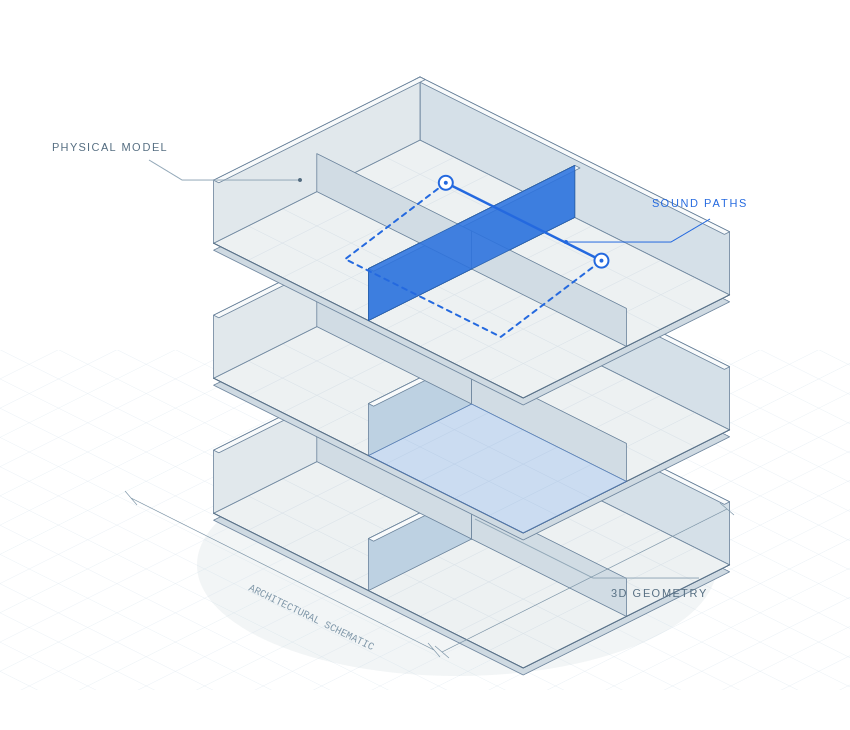
Sound insulation design is often split across 2D drawings, spreadsheets, and standalone tools that don't share one model. We bring geometry, construction, and transmission paths into a single traceable workspace that runs in the browser. ISO 12354-based calculation is in active development.
Our vision
Acoustic comfort should be designed in from the first drawing, not fixed after construction.
Designed for
Model junctions and flanking paths, not just wall ratings.
Understand acoustic relationships while the design is still open.
Keep constructions, geometry, and requirements in one model.
02 /The platform
Acoustic design is more than the insulation value of a wall. It starts with understanding how rooms, floors, and junctions connect.
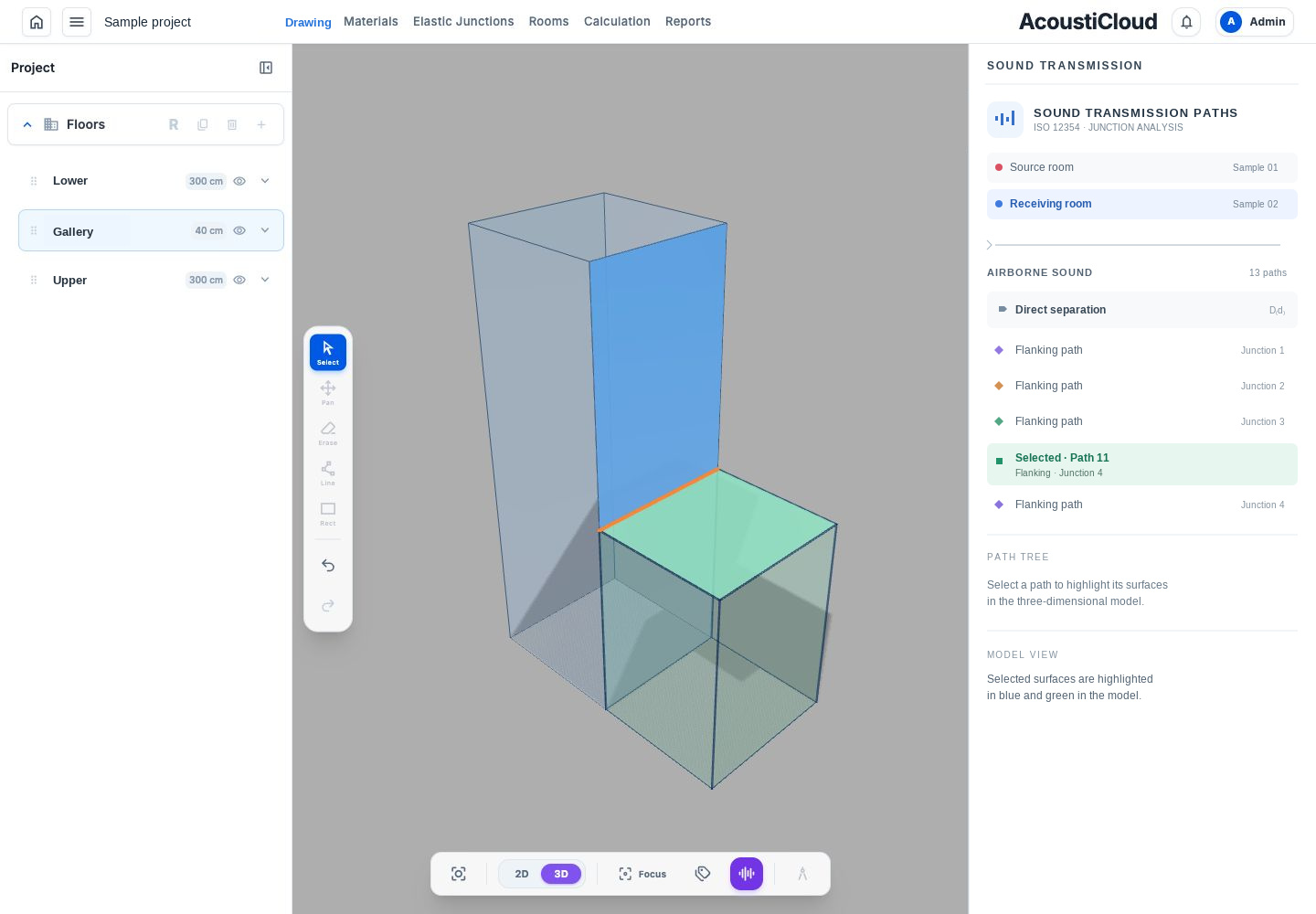
Start with DXF import. Work with floors, room geometry, and heights in 2D and 3D views.
Define materials and construction layers. Inspect walls, floors, and junctions alongside their geometry.
Explore direct and flanking routes between room pairs. See the selected path and its surfaces in the model.
03 /Engineering & technology
Geometry is an input to the calculation, not just a visual. The engine is being developed around the ISO 12354 framework, which estimates building acoustic performance from the properties of its elements, including direct and flanking transmission across junctions.
Direct and flanking routes share the same physical model.
Conceptual illustrationEngineering principles
Every result is designed to link back to the surfaces, junctions, and paths behind it.
Designed so the same inputs always produce the same numbers, with no hidden steps.
Rust is compiled to WebAssembly, so the solver is designed to run in the user's browser. Numerical development and validation are ongoing.
04 /Acoustic Design Co-pilotPlanned
We're planning an Acoustic Design Co-pilot built on Claude by Anthropic. It will work alongside the deterministic engine, reading the project model and engine results to help engineers understand, iterate on, and communicate their designs.
Geometry, constructions, junctions
Deterministic calculation
The only source of acoustic valuesExplains, suggests, drafts
Reviews, decides, recalculates
What it will do
Describe in plain language which flanking path dominates a room pair, and why.
Propose construction or junction alternatives for elements that miss a target, for the engineer to evaluate and recalculate.
Prepare report narratives and client summaries from verified engine output.
How it's designed
Sound insulation values will always come from the deterministic engine. The co-pilot will never generate them.
Suggestions will be proposals. Nothing in the model will change without confirmation.
Answers will reference the project's own elements, paths, and results.
Planned. Not yet available in the private beta.
05 /Where we are today
AcoustiCloud is a private beta in active development. Below, what is in beta today is kept separate from what is still in development and what is planned.
October 2026 · Development status
DXF import, 2D/3D editing, and material setup workspaces.
Inspect room pairs, physical junctions, and direct or flanking routes in the model.
The Rust/WASM acoustic engine, comparison with targets from the Turkish regulation on protecting buildings against noise, PDF reporting, the end-to-end calculation flow, and numerical validation are in development.
A planned Claude-based assistant. Acoustic values will stay with the deterministic engine.
Roadmap
Modeling, junction and path inspection in private beta.
End-to-end ISO 12354-based calculation, numerical validation, regulation comparison, and PDF reports.
The Claude-based Acoustic Design Co-pilot.
06 /Team & vision
AcoustiCloud was co-founded by Berkay and Ergin Gürkan. Our Istanbul-based team brings software engineering, acoustic architecture, and product design together around a single product.
Our vision
Acoustic comfort should be designed in from the first drawing, not fixed after construction. We're building the engineering workspace that makes that the default.
Co-founder · Software Lead
Mechatronics engineer and researcher with published work in control systems, signal processing, and machine learning. Leads product engineering: the browser workspace, 3D modeling, and the Rust/WASM calculation infrastructure.
Co-founder · Acoustic Architecture Lead
Architect with more than ten years of experience in architectural acoustics. Leads the acoustic methodology: construction data, junction modeling, and the calculation approach.
Software · Design · Acoustic engineering
Works alongside the co-founders across product development, interface design, and acoustic engineering.
07 /A few useful details
The platform is in private beta. You can request beta access from the contact section below. The app sign-in link is for users who have been granted access.
The acoustic engine is designed to run in the browser. Projects can be saved as local files, and optional account-based cloud storage is also available. Running the calculation locally does not mean all project data always stays on the device.
The engine is being developed around ISO 12354 building sound insulation models. Testing and validation of geometry, junctions, and transmission paths are ongoing. The platform is not yet presented as a complete, independently certified compliance assessment tool.
Contact & beta access
Choose the route that fits. Every message reaches our team directly.
Write directly: hello@acousticloud.live